24/4/2007
Wish you were here: Ida Presti
April 24th 2007 marks 40 years from the death of one of the greatest guitarists of the 20th Century, one of my 'guitar heroes', Ida Presti.
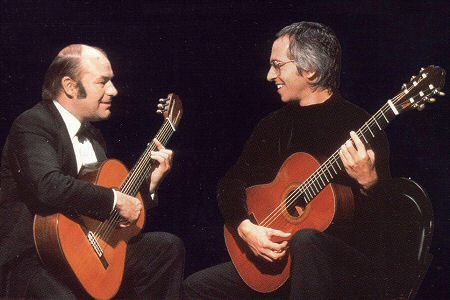
Over many years I have felt uncomfortable as I noticed that Alexandre Lagoya hardly ever mentioned Ida Presti. When he did, in most cases he was giving information about concerts they did together, but referring to them as though it had been he alone performing them. It always upsets me whenever I find out that some of my pupils have not even heard of her. So I couldn't wait to read this book that I would like to present to you.
IDA PRESTI
Her Life, Her Art
By Anne Marillia and Elisabeth Presti
Berben, Ancona E.5210 B.
Softback 199 pages
Written by Anne Marillia, a friend as well as a student of Ida Presti with the help of her daughter Elisabeth Presti, this is the first full-length biography of one of the greatest guitarists of the 20th Century, Ida Presti. The book is printed in A4 format and is a pleasure to read. An English translation written by another pupil and friend of Presti's, Alice Artzt, is presented side by side with the original French text.
The beginning is fascinating and one learns things that were not widely known before about her childhood and adulthood. There are comments from people who knew her as well as amusing anecdotes. The well-known photograph taken in the house of Andre Verdier in 1950, which shows Presti's left hand stretch; a 4 note chord of all “E”s, with eight frets in between the first finger and the little finger, never ceases to amaze. I found it amusing that when Presti suggested to her mother that she cut her hair with no results, she tried a radical method and did the job herself while her mother was asleep. Later on, I found funny the story that when in Russia the duo found out that they had to spend their fee in the country so they decided to buy caviar instead.
Returning back home all the family, as well as any students who were there at the time, had to consume about 9 kilos of caviar in the weeks to follow. They even had it for breakfast!
The book is nicely written and there are many photos. We learn about her everyday life and the way she thought. I enjoyed reading about the way she was teaching as well as about her compositions.
Unfortunately very little research has been done for the time period and events that we know so little about. But we are given lots of information on the periods that we do know about because of the extensive documentation saved by her father and by Lagoya. These periods are before 1938 (the death of her father), and of course the period of her duo with Alexandre Lagoya.
This summer, after some concerts in the south of France I visited Allauch, the village she lived with her first husband, Mr. Rigo. Unfortunately he had moved from the village and from the address I had. But I could visualize how it would have been for the great guitarist Ida Presti, living in this charming village not that far from Marseilles. It is natural that one could not expect to find much information about what many people did during the War Years (1939-1945) especially those who, like Presti, didn't move to USA or South America. I felt it would have been essential to have in the book some information given by Mr. Rigo himself. However, we do learn that he was helpful dealing with Presti's correspondence after his workday. We are also told that after the war ended, he was the one who urged the family to go to Paris for the sake of Presti's career. He rightly felt she had no chance otherwise.
We are given some description of her solo career during the period of her return to Paris, but it's all very general! Presti stopped performing as a solo player in 1955. The information we are given about the period –a whole decade– is vague and rather 'thin'. I missed not having exact dates of events such as, for example, the premiere in France by Presti of the Aranjuez Concerto by J. Rodrigo. We are given the year 1947, but no exact date, orchestra, or location. I feel uncomfortable that there is no exact source of information about this and other events that were landmarks in her career.
Biographies that are written by people very close to their subject always have a danger of not being objective. I felt this was the case with this book. I have the strong feeling that this biography was written with a preconceived agenda, and also that it has not been researched enough in a scholarly manner.
The last two chapters of the book, in particular, give the strong impression that the authors wish to portray Presti as a deeply unhappy person. The poverty during her early years was indeed horrible, but during the war years and afterwards, a lot of people suffered similar hardships. This was a universal reality during the war years, when everybody was in difficulties. And it seems to me that Presti also had good friends in high places to help her. We read that, due to her guitar, Presti lived a miserable life, she had no childhood, and later on she suffered having to tour and to perform.
It is in these sections in the book that her religious and spiritual beliefs are described. There is also a hint of hagiography that made me feel uncomfortable – reading about 'her great soul' or about her confiding to the writer A. Marillia that “je n' aime pas la vie” (I don't like life). The writers constantly emphasize that she had such a difficult life. But everyone who met her always speaks about how warm, loving, and joyful she was. I was not convinced by reading this book that, on the contrary, she was so unhappy and was almost forced to tour the world playing her guitar. Many musicians, including myself, when away, want to come back home (sometimes even complaining about it). And how many are the performers who say that they just don't like the traveling part of touring? A lot, I assume. But after being at home for a while, we all want to leave again. Presti is admired for her superb playing. Though I didn't know her personally, I have listened to people who knew her over the years, yet I never had from any of them this impression of Presti as portrayed toward the end of the book. Was this rather the desire of her daughter Elisabeth, to have her mother stay at home playing with herself, her family, and her brother – of her wanting Presti to be with them, rather than the desire of Presti herself?
There have been a lot of 'versions' of Presti's death. We have read that she died from an aneurysm, or after anaesthesia before an operation, or that the doctors 'killed her', and also of her having lung cancer. In the book we read that she began to cough up blood very violently, and that this continued yet more violently during the flight the next day. According to the authors, when Presti was taken to the hospital, the doctors should have put her under observation rather than do a bronchoscopic examination that hurt a 'tiny tumor' and caused a pulmonary haemorrhage. Well, this doesn't make sense either. But of course Presti's death is equally tragic, no matter what the cause was.
Ida Presti, her Life, her Art is a book well worth buying since it is the only book we have on this great guitarist apart from a CD and a video. It is well written and absorbing to read. However, although this is the only book on Presti's life, it should not be taken as the 'authority' for information, even though it was written by her daughter, and her pupil and friend. I would like to emphasize once again that this is not an objective account of her life. I must also say that the price of 68 euros is ridiculous for 100 pages, in paperback yet! In a sense, the price is the No1 enemy of the book and may put off a lot of her aficionados. It certainly wouldn't tempt those that have not even heard of her to buy it. As the author A. Marillia writes: “You may search in vain for the name Ida Presti in a music dictionary; it's not there”.
I thought to also forward an article I wrote years ago for Classical Guitar magazine (UK) entitled “Wish you Were Here” (click here to view).
I am also including some photos from my private collection (click here to view).
I find it’s very important to attach an explanatory article that Alice Artzt wrote. She was with Presti during the last days of her life, and was with Lagoya at the hospital after her death, and what she writes give another light, to my opinion a very convincing one, in explaining Presti's death.
Alice Artzt writes: “The single thing I found most distressing about the book was the inaccurate description of Ida Presti's death. The lack of clear information, and the desire to spread false rumours by some parties for their own reasons, has created piles of unhealthy speculation and lurid discussions throughout the intervening years about her being killed by incompetent doctors, or even being murdered. I would like to finally put these rumours to rest. Here are the facts: She died in the Strong Memorial Hospital (a large, famous, and very well regarded teaching hospital) in Rochester, on the operating table on Monday April 24th 1967 in the early evening. At that point, she had been violently coughing up blood for two days. She and Lagoya were in the middle of a concert tour of the USA, and the day before, because of the apparent seriousness of her condition, she had gone to the hospital in St Louis where the doctors examined her, took X-rays, and cautioned that her condition might be very serious and that she should remain in the hospital. She and Lagoya decided to travel on to Rochester (where their next concert was to be held) anyway. During the trip she continued vomiting blood, spending much of the 4 hour and 37 minute flight (AA 534 with two stops) in the lavatory of the plane, and upon their arrival in Rochester, she was brought to the hospital in a very weakened condition straight from the airport. She died of a massive internal haemorrhage during a prolonged attempt by the doctors to stop the bleeding. I received a phone call from Lagoya that evening, telling me of Presti's death and asking me to come to Rochester as fast as I could to help him with the formalities, which I did. The next morning in Rochester, I spoke at some length to the doctors who had tried so hard to save her, and they explained to me that when someone enters the emergency room in an extremely weakened condition, haemorrhaging violently, with a history of already two days of such haemorrhaging, the only hope is to do an emergency operation as quickly as possible to attempt to get the bleeding stopped.
More recently, I also spoke about her case at great length to a thoracic surgeon in Princeton, and one of the questions I asked him was why the doctors in St Louis had not seen her tumour in their X-rays, and so were not completely sure of the cause of the internal bleeding at that point. He explained to me that since the tumor Presti had would have been located right behind her heart, even a very large tumour would not have shown up at all on the X-rays, since the heart would have obscured any possible view of it. He said that at that time, without the help of a CAT scan (which didn't exist then), the only way of finding out what was going on in such a situation would have been to operate. He told me that the desperate emergency situation faced by the doctors in Rochester was every surgeon's nightmare, since there is so very little hope of saving the patient in such cases, no matter what one does. The idea put forth in the book, that the doctors in Rochester erred in not simply standing by doing nothing and observing Presti as she haemorrhaged yet more blood and weakened further, is totally ridiculous. Presti died tragically too young, but it was her own long-standing disease, and her own death, and probably inevitable by then within a fairly constrained time period. She was not killed by the doctors or by anyone else.
It is still my hope that, despite its flaws, this book will stimulate a renewed interest in this amazing woman, Ida Presti, and that more books, videos, and articles about her will follow. Presti deserves to be much better known by all who love the guitar, and perhaps now, forty years after her death, there will be the beginning of a renaissance of interest in her life and art.”
Eleftheria Kotzia(April 2007)
eleftheriak@tiscali.co.uk
Source :
www.tar-radio.com/myapp/ categories/view